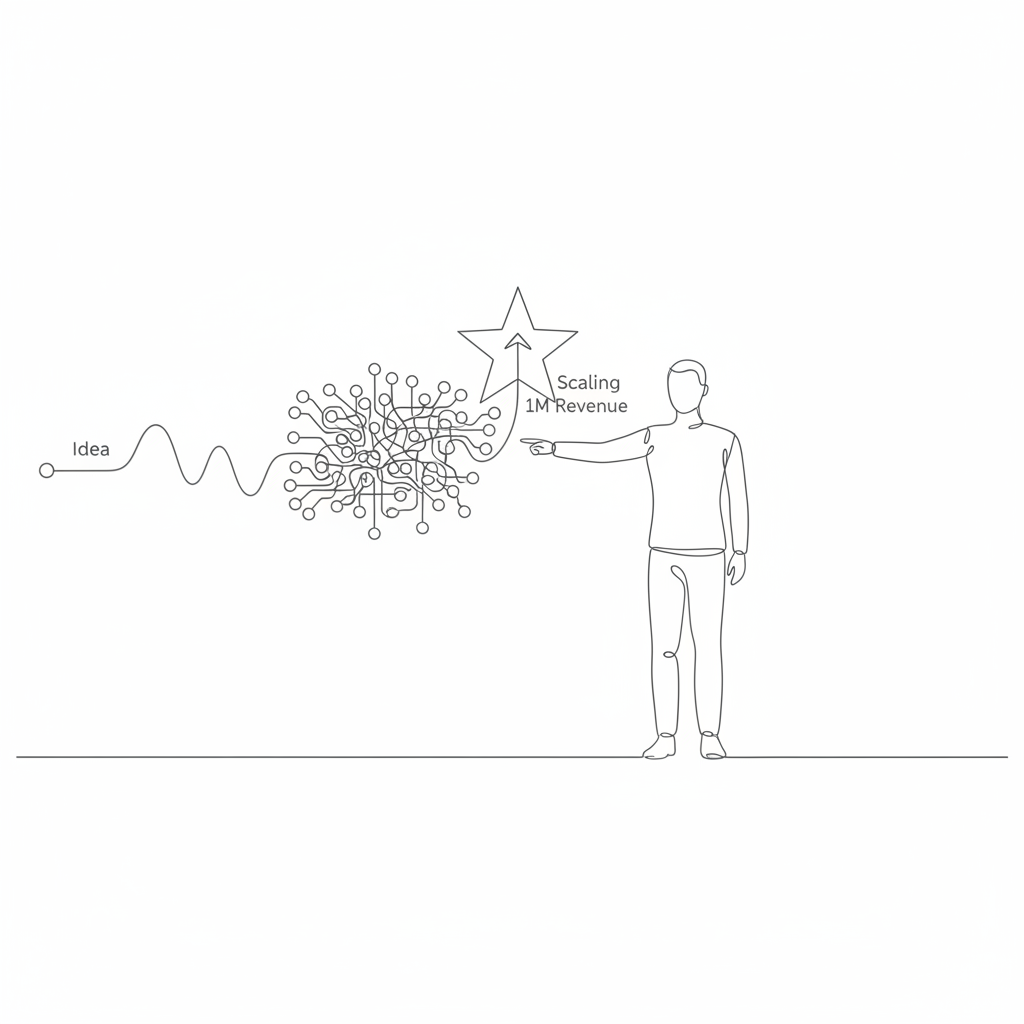
Building a startup is not a single decision — it's a chain of small, deliberate moves. From the first spark of an idea to real revenue, every stage has its own logic, risks, and shortcuts that actually work.
This guide breaks down the full journey into 10 practical stages — based on patterns from real startups, not theory.
1. How Founders Find the Right Idea
Most founders don't sit in a room brainstorming billion-dollar concepts. There's no whiteboard full of "next unicorn" ideas. Instead, they run into problems in real life… and decide to fix them. That's where most great startups actually begin.
Solve Personal Pain
"I built it because I needed it." When you experience the pain yourself, you understand the user better than any survey ever could.
Observe Community Friction
Watch forums, Reddit threads, Discord groups, comment sections, and support tickets. Patterns appear fast.
Spot Platform Gaps
Platforms create ecosystems — and ecosystems always have unmet needs. Where there's dependency, there's opportunity.
Solve Personal Pain Points
"I built it because I needed it."
Many successful products come from founders solving their own frustrations. The founder of Gravl was a regular gym-goer who felt workout apps were unsafe and poorly designed — so he built a better training engine. LaunchFast was born after its founder spent 30+ hours doing manual Amazon product research and decided to automate the process.
When you experience the pain yourself, you understand the user better than any survey ever could.
Observe Community Friction
Sometimes the pain isn't yours — it's the community's. Founders often watch:
- Forums
- Reddit threads
- Discord groups
- Comment sections
- Support tickets
Patterns appear quickly: repeated complaints, workarounds, and "why doesn't this exist?" moments. That's signal for action!
Spot Platform Gaps
Another powerful path is watching where platforms fail their users. Data Fetcher was built after scanning Airtable forums and noticing repeated complaints about missing integrations. Uneed launched as a Product Hunt alternative after developers complained they weren't getting visibility on existing launch platforms.
Platforms create ecosystems — and ecosystems always have unmet needs. Where there's dependency, there's opportunity.
2. How Do Founders Test if an Idea Is Worth Building?
An idea sounds great in conversations. Friends like it. Twitter likes it. Communities say "cool." But validation starts only when people are willing to commit — time, money, or reputation.
Build awareness before the product exists. Show the concept, the workflow, the outcome. Push Scroll validated demand with a viral demo video — before building anything.
Sometimes validation takes one post. A ghostwriting agency tested demand by tweeting a premium service offer for executives. High-ticket buyers replied. No website. No funnel. No product.
One of the strongest signals. Subscribr made $20,000 before building anything by selling 50 lifetime licenses. That revenue didn't just validate demand — it funded development.
Even small payments change everything. If users leave deposits, join paid waitlists, buy early access, or reserve licenses — demand is real. Money separates interest from intent.
3. How Do Startups Find Their First Clients?
Early traction rarely comes from ads. It comes from communities + conversations.
Niche Communities
Gravl and Elephas shared progress in Reddit communities like /r/selfhosted and /r/MacApps — gaining their first thousands of users.
Viral Content
Natural Write got its first sale from its very first TikTok video. Content that resonates spreads — and early sales follow.
Partnerships
LaunchFast partnered with a coaching company that already had thousands of Amazon sellers — trading equity for distribution.
4. How Do They Define Their Niche and Target Audience?
Startups grow faster when they niche down. It's impossible to cover all cases — it's better to solve one that truly matters to users.
5. How Much Do I Need to Build My Product?
The honest answer — it depends. On the idea. On the complexity. On what you actually need to prove first. Because building a product doesn't always start with development.
A few well-crafted posts on X, LinkedIn, or niche communities can find your first audience, attract supporters, reach partners, or even get investor attention. You're finding people who want the idea to exist.
Begin with product visuals, UX screens, landing pages, and demo flows — before writing real code. Visuals help people understand the outcome, not just the concept. Understanding drives interest.
Start with a small demo that shows core functionality, key workflow, and main value proposition. If the demo resonates, you expand. If not, you pivot cheaply.
Deep tech, AI/ML, blockchain, real-time systems, or complex integrations need technical support early. Architecture decisions at the start define cost, scalability, and time to market.
6. How Long Does It Take to Reach First Revenue?
It varies wildly. Some startups monetize almost instantly — especially if they already have an audience, distribution channels, pre-sales, or community trust. Others take much longer. Because revenue speed isn't only about the product. It's about access to buyers.
Lovable, a Swedish AI startup, raised $200M and reached a $1.8B market cap — all within just eight months.
- • Market timing
- • AI hype wave
- • Investor access
- • Strong positioning
Stage Timer needed 224 days to earn its first dollar. That's over seven months just to validate revenue.
Puff Count took years to scale meaningfully. Growth came slowly — through iteration, positioning, and audience building.
Why Timelines Differ So Much
Revenue timing usually depends on:
- Existing audience access
- Founder brand/credibility
- Market demand urgency
- Pricing model
- Distribution strategy
Not purely on build quality. A great product without distribution can stay invisible. A simple product with strong distribution can monetize fast.
7. What Are the Monthly Operating Costs?
Lean SaaS can run surprisingly cheaply. In the early stage, infrastructure is no longer the biggest barrier — thanks to managed services, serverless tools, and pay-as-you-go pricing.
Lightweight products covering:
- • Cloud hosting
- • Database
- • Storage
- • Auth systems
- • Notifications
- • Basic APIs
Compute-heavy products scale cost alongside usage:
- • Code Guide: ~$3,500/mo on AI API usage
- • Neural Frames: up to $45,000/mo on GPU infrastructure
8. How Do Small Startups Compete with Industry Giants?
They don't try to act big. They win by being:
Startups ship features in days. Enterprise competitors take quarters due to approvals and process.
Focused products that do one thing well, instead of bloated enterprise suites with features nobody uses.
Real conversations, direct support, community-driven roadmaps — things big companies struggle with at scale.
9. How Do They Make Money?
Once users are active, monetization usually follows proven models. Founders rarely invent new revenue mechanics — they use frameworks that already work across SaaS, mobile apps, and other tech products. The model depends on product type and how users receive value.
10. How Do Startups Grow to $1M Revenue?
Reaching the first million usually doesn't come only from building the product. It comes from scaling distribution. At a certain stage, growth is driven less by features and more by how many people consistently discover the product.
Engineering as Marketing
Building free tools that attract users through SEO and organic discovery. SiteGPT grew by launching free SEO utilities that funneled users into the core product.
Content Engines
Using content as a daily acquisition channel. Arvow scaled to ~$70K MRR through consistent YouTube content that educated and converted viewers.
Portfolio Strategy
Some founders run multiple niche apps — each generating $100K+ annually — compounding revenue across a portfolio instead of relying on one product.
Final Thoughts
Building a startup is not one big leap. It's a sequence of small, deliberate moves — each informed by real signals, not assumptions.
Every stage in this guide maps to a decision you'll face. The founders who succeed aren't the ones with the best ideas — they're the ones who test, learn, and move forward faster than everyone else.